

What a move undoes
Leveling appliances after a move is only part of the job. Movers tip, drag and turn machines, and the new floor is never quite the old one. The laundry machine's feet were set for a different slope, the anti-tip bracket for the cooking appliance was screwed to the previous house's floor, and the gap the refrigerator had behind it has shrunk because it was pushed hard against a new wall.
None of this shows on the first day. It shows later as a spin cycle that walks the machine across the room, a dish care door that drifts, a refrigerator that runs longer than it did, or ice cubes that come out small. A careful hour on arrival avoids most of it.
The order that saves repeating work
Set each appliance in its final spot first, then level it, then connect water, then check airflow and clearances, and only then run it. Leveling after the water line is attached means pulling the machine forward again, which is how lines get kinked in the first place.
Laundry: shipping bolts, feet and a solid floor
Front-load laundry machines are shipped with bolts that lock the drum. LG tells owners to save those bolt assemblies and to reinstall them before moving the machine, since moving it without them can damage its internal parts. At the new home they come out again before the first load; a drum still bolted in place shakes violently on its first spin.
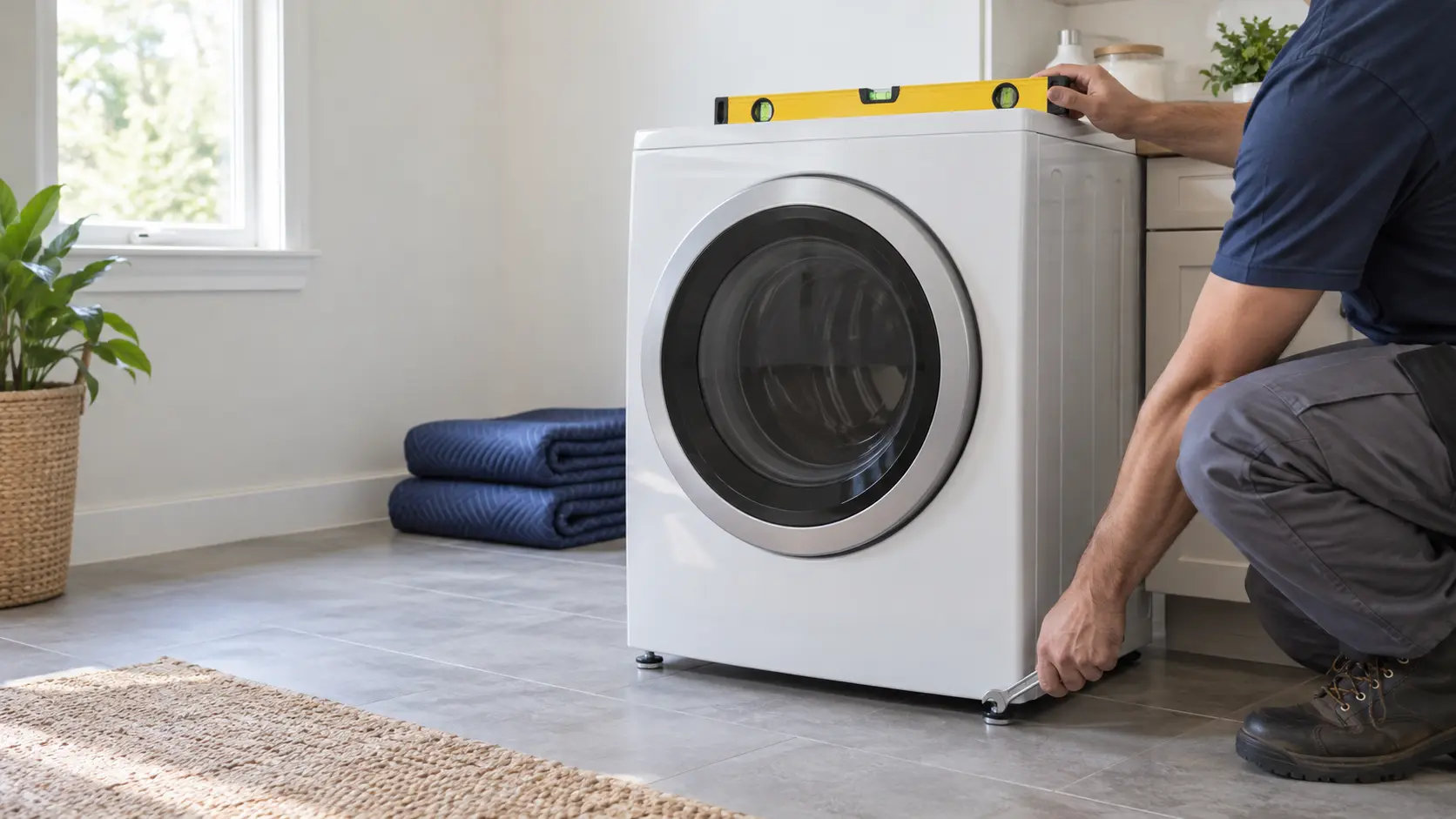
LG wants a floor that slopes no more than 1 inch front to back or side to side, and prefers concrete. Whirlpool's test for level is simple: with the machine standing on all four feet, try to rock it diagonally, corner to corner, and adjust the feet until it no longer teeters, then tighten the lock nuts against the cabinet. Speed Queen asks the same of its drying machines: level side to side and front to back, with no rocking.
- Shipping bolts out, and saved in a bag taped to the back of the machine
- All four feet in firm contact with the floor
- Lock nuts tightened so the feet cannot spin back
- The stacking kit or pedestal bolts retightened on a stacked or raised pair
When the floor itself moves
A laundry pair on an upper floor or an older wood subfloor may shake even when perfectly level. Whirlpool notes that a vibration felt across the room can mean the floor is flexing, and suggests securing a piece of 3/4-inch plywood to the floor under the machines to stiffen it.
Source: LG Electronics — Washer owner's manual (WM4080) — Save shipping bolt assemblies and reinstall them before transport; floor slope no more than 1 inch; concrete best; after freezing, stand at room temperature for several hours and check for leaks; Whirlpool — Leveling a front load washer — All four feet in firm contact; rock diagonally and adjust until it does not teeter; tighten lock nuts; a flexing floor can be stiffened with 3/4-inch plywood; Alliance Laundry Systems (Speed Queen) — Installation instructions for dryers, D516902 — Adjust the legs until the dryer is level side to side and front to back; it must not rock

Cooking appliances: brackets, burners and the regulator
A freestanding or slide-in cooking appliance must be hooked to its anti-tip bracket in the new kitchen. GE's manual says to re-engage the bracket whenever the appliance is moved, and CPSC describes a simple check: with the oven and top cool and nothing on top, grasp the back and try to tilt it toward you. If it tilts more than an inch, the bracket is not engaged or not attached properly.
Gas models need a fresh hookup, and GE's gas instructions forbid putting the old flexible connector back into service. Whirlpool adds a transport quirk: the pressure regulator on its gas ranges has its own shutoff that can be turned off in handling, so the surface burners light but the oven gets no gas. Both are jobs for the installer or a technician, not the moving crew.
Source: GE Appliances — Electric free-standing ranges owner's manual (49-2000951) — Re-engage the anti-tip bracket if the range is moved; CPSC — Tips on checking your range's stability — Try to tilt the range toward you; more than an inch means it is not engaged or the bracket is not attached properly; GE Appliances — Dryer owner's manual and installation instructions (49-3000386) — Use a new approved flexible gas connector; never reuse old flexible connectors; Whirlpool — How to check the gas regulator shut-off valve on an oven — The regulator shut-off may be turned off during handling or transport, leaving the burners working and the oven without gas
Cold storage: level doors, a clear rear gap and a fresh filter
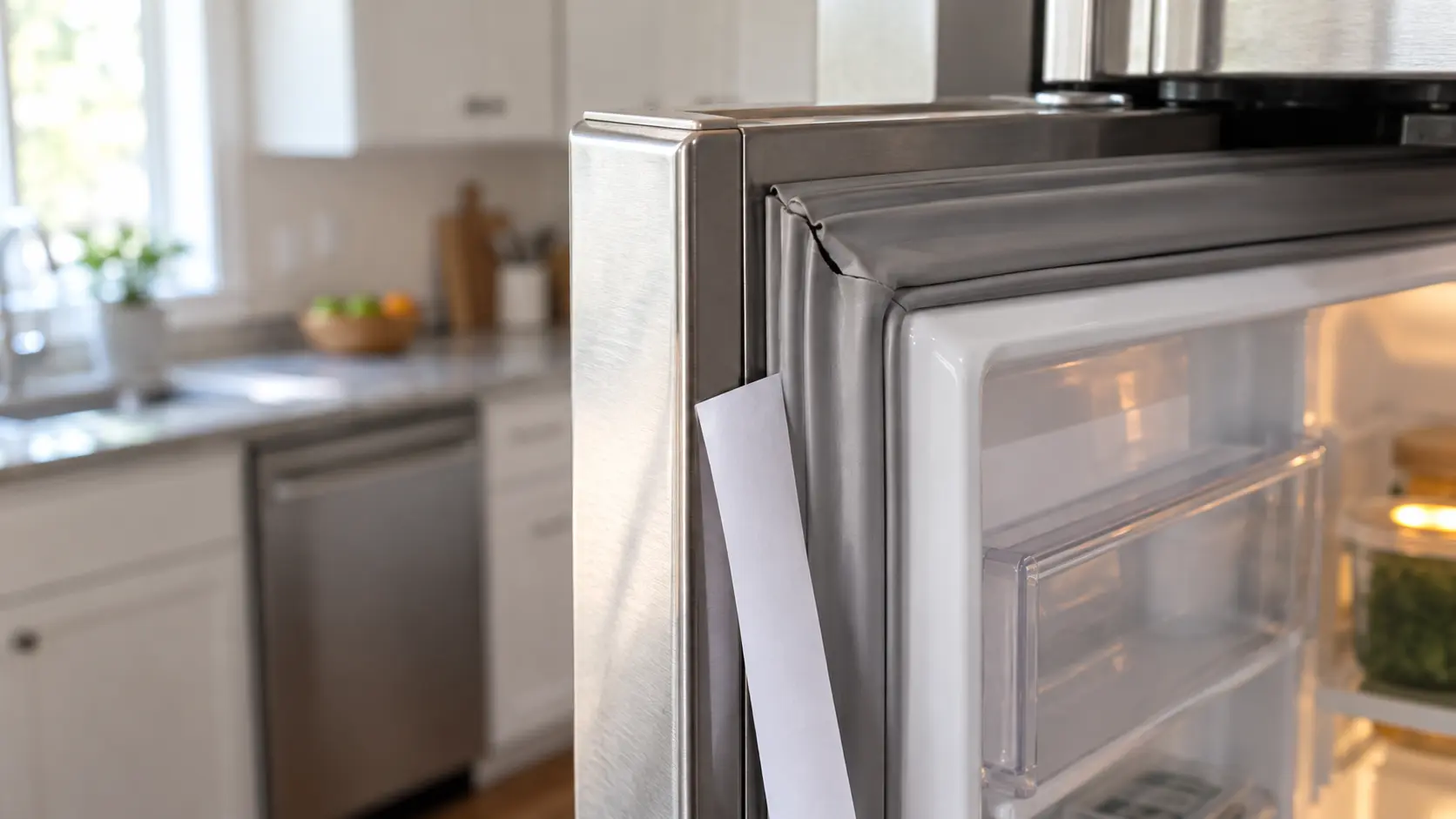
A refrigerator set up the way its manual directs, on a floor strong enough for it, lets its doors swing closed and seal; Viking notes a loaded built-in can weigh around 1,200 pounds. Once it is in place, the rear gap needs checking: ENERGY STAR advises a few inches between the wall and a freestanding refrigerator, and GE asks for about 3 inches around the top and sides of most freezers. Built-in units get their clearance from the opening and breathe through the front grille, so the grille must be clear of any new trim or rug.
Water comes next. Whirlpool reminds owners to check the supply line for kinks after a refrigerator has been moved, since a pinched line gives slow dispensing and small cubes. Frigidaire recommends putting in a new water filter before reinstalling a refrigerator that has sat unused for a while, as it does during a move.
- Refrigerator level side to side, doors closing on their own
- A few inches of air behind freestanding units; about 3 inches around most freezers
- Water line checked for kinks before the unit goes back
- New water filter fitted, and the first gallons run to waste
Source: ENERGY STAR — Refrigerators — Leave a few inches between the wall and the refrigerator; GE Appliances — Upright and chest freezer: exterior case warm — Most upright and chest freezers need about 3 inches of air clearance on the top and all sides; Whirlpool — Ensuring correct water pressure (refrigerators) — Check the water supply line for kinks, especially if the refrigerator was moved recently; Frigidaire — How often should I change my water filter? — Change the filter before reinstalling a refrigerator that has not been used for a period, such as during a move; Viking — FBI7360W built-in refrigeration use and care manual — Install and level the refrigerator on a floor that will hold its weight plus food, approximately 1,200 pounds
Winter moves and machines that sat in the cold
A truck or storage unit in winter can leave water frozen inside pumps, valves and hoses. LG says a laundry machine exposed to freezing temperatures before installation should stand at room temperature for several hours before use, and be checked for leaks before it runs. The same patience suits any appliance that holds water, from a dish care machine to an ice maker, since a cracked fitting only shows itself when water flows.
Watching the first run
Stay in the room for the first cycle of each water appliance. Look under the machine with a flashlight at the start of the fill and again at the drain, and feel the connections with a dry tissue, which shows a seep long before a puddle forms.
Source: LG Electronics — Washer owner's manual (WM4080) — Save shipping bolt assemblies and reinstall them before transport; floor slope no more than 1 inch; concrete best; after freezing, stand at room temperature for several hours and check for leaks