Dust on the parts whose job is to move heat
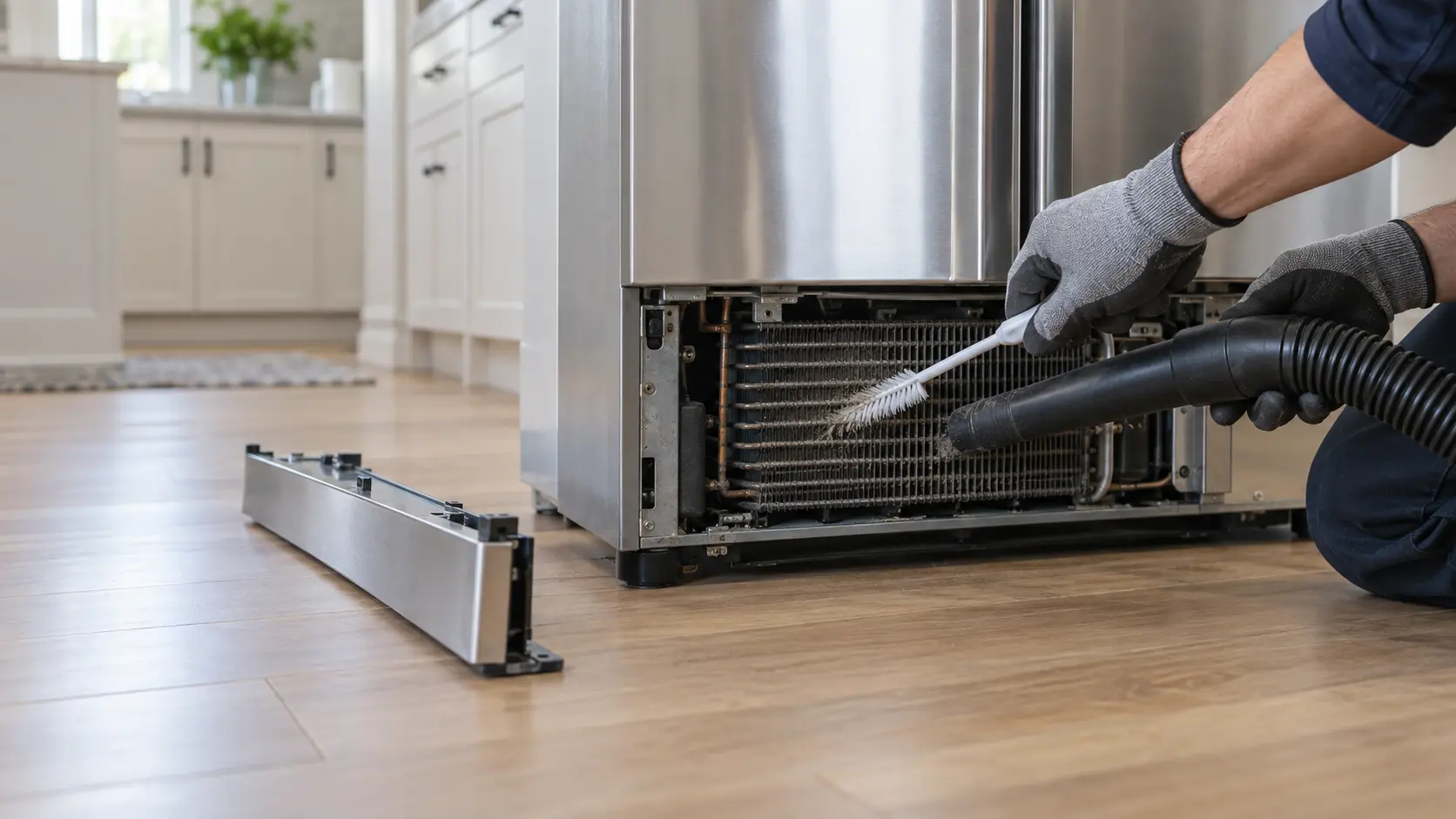
Cold storage works by pumping heat out of the food compartments and dumping it into the kitchen through a condenser coil. Every fiber of dust and pet hair on that coil is insulation in the wrong place. ENERGY STAR tells owners of older models to keep the condenser coils clean and to leave a few inches between the wall and the cabinet, and to read the manual for how to do it safely.
Makers of built-in units are more specific. Viking recommends cleaning the condenser of its built-in columns once every six months, and sooner after any construction dust in the kitchen. The coil on those units sits behind a kick plate or top grille rather than on the back, which is why it tends to go years without anyone seeing it.
Why a dusty coil costs twice
A coil that sheds heat slowly makes the compressor run longer to hold the same temperature, which is the first cost. The second is heat: longer runs keep the compressor and the fan motor hotter for more hours a day, and heat is what ages motors, relays and the start components beside them. The electric meter shows the first cost; the second shows up years later as a repair.
Source: ENERGY STAR — Refrigerators — Keep condenser coils clean on older models and leave a few inches from the wall; an old refrigerator uses about 20% more energy than a certified one; certified models are about 9% better than the federal minimum; Viking — FBI7360W built-in refrigeration use and care manual — Clean the condenser once every 6 months, and after construction work that produces dust near the unit
Air that cannot leave: lint, grease and a narrowed exhaust
Laundry and cooking appliances lose efficiency through the air they push out. A dryer heats air, sends it through the load and out a duct; anything that narrows that path means a longer cycle and a hotter cabinet. ENERGY STAR says cleaning the lint filter after every load improves air circulation and efficiency, and that owners who use dryer sheets should scrub the filter with a toothbrush once a month because the sheets leave a film that restricts airflow and can wear on the motor.
Some dryers now measure the problem for you. LG lists d75, d80, d90 and d95 on its display to mean the exhaust is 75, 80, 90 or 95 percent restricted. Over a range, a grease-loaded hood filter works the same way in the other direction: the fan runs at the same speed and moves less smoke.
- Lint screen: after every load, and scrubbed monthly if you use dryer sheets
- Exhaust duct and outside flap: checked for crushing and blockage between cleanings
- Hood grease filters: washed on the interval in the hood's manual, or when the filter light asks
- Condensing and heat pump dryers: their own lint and condenser filters, which have no outside duct to warn you
Source: ENERGY STAR — Clothes dryers — Clean the lint filter after every load to improve air circulation and efficiency; scrub it monthly if you use dryer sheets; heat pump dryers use around 70% less energy; LG — Dryer error code list (archived copy) — d75, d80, d90 and d95 mean the exhaust duct is 75, 80, 90 or 95 percent restricted

Scale on anything that heats or sprays water
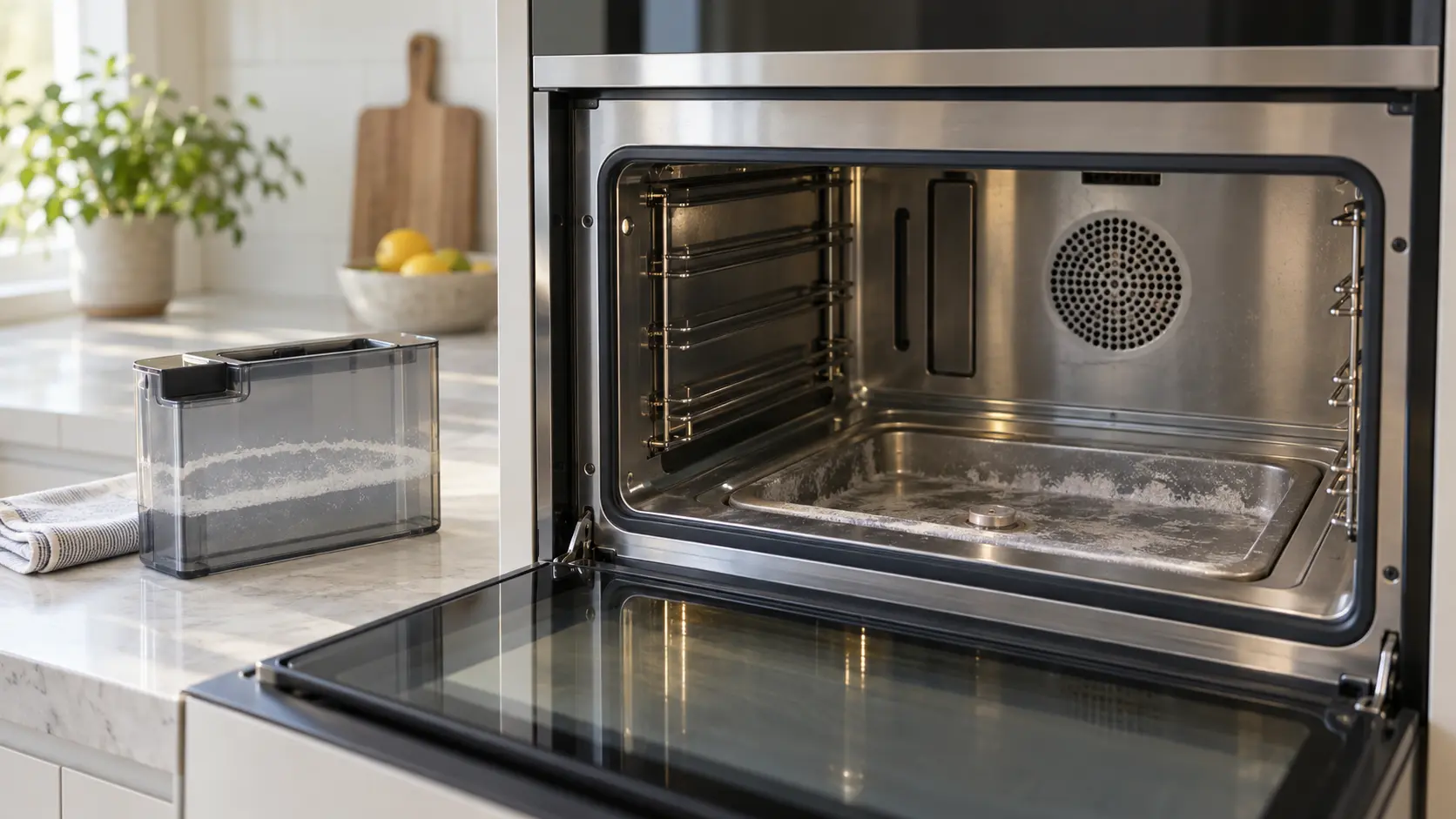
USGS explains that heating hard water deposits solid calcium carbonate, and that this scale can shorten the life of equipment and lower the efficiency of electric water heaters. Dishwashers, steam ovens, built-in coffee systems and the heating element of a washer all heat water, and every one of them collects the same crust in proportion to the hardness coming in.
Scale is the reason descaling intervals vary so much. Wolf says its convection steam ovens typically need descaling every 6 to 18 months, depending on use and water hardness. In a dishwasher, Whirlpool notes that efficient machines depend on rinse aid to sheet water off the dishes, and suggests a higher rinse aid setting when rings or hard-water spots appear.
Knowing which band your water falls in
USGS classifies water by dissolved calcium carbonate. A utility's annual water quality report usually gives a hardness figure, and a maintenance log that notes it explains why one home descales twice as often as the house next door.
- 0 to 60 mg/L: soft
- 61 to 120 mg/L: moderately hard
- 121 to 180 mg/L: hard
- Above 180 mg/L: very hard
Source: USGS — Hardness of water — Heated hard water deposits calcium carbonate scale that reduces equipment life and efficiency; hardness bands 0–60, 61–120, 121–180 and above 180 mg/L; Wolf — Convection steam oven descaling — Descaling is typically needed every 6 to 18 months depending on use and water hardness; Whirlpool Product Help — Filling and adjusting the rinse aid dispenser — Efficient dishwashers depend on the sheeting action of rinse aid; use a higher setting for rings or hard-water spots
Gaskets, sensors and leveling that drift over the years
Not every loss is buildup. Door gaskets on refrigerators, freezers, dishwashers and ovens stiffen and take a set, and a gasket that no longer presses evenly lets warm, moist air into cold storage or lets heat escape an oven cavity. Cabinets settle on their feet, floors move, and a door that used to swing shut from half open now stops a few inches short.
Sensors drift for a quieter reason: they get coated. Samsung explains that dryer-sheet residue on the moisture sensor bars can make a dryer think the load is dry and end the cycle early, and that the bars clean up with a soft cloth and mild soap. A coated sensor wastes energy in the other direction too, because the owner runs a second cycle to finish the job.
A door that stopped closing itself
GE's instructions for one of its top-mount refrigerators set the front leveling legs so the front sits just high enough that a door opened halfway closes easily. After a move, a new floor or years of loading, that tilt disappears. Resetting the level is a small job during a maintenance visit, and it stops a slow air leak that no amount of coil cleaning would fix.
Source: Samsung — How to clean your Samsung dryer — Dryer-sheet residue on the sensor bars can end Sensor Dry cycles too soon; clean them with a soft cloth and mild soap
What upkeep cannot win back
Cleaning restores an appliance to what it was on the day it left the factory, and no further. ENERGY STAR estimates that an old refrigerator uses about 20% more energy than a model that has earned its label, and that certified refrigerators are about 9% more efficient than the federal minimum. Insulation, compressor design and controls were set in the year the unit was built.
For dryers the gap can be larger: ENERGY STAR says certified heat pump dryers use around 70% less energy than conventional ones. That does not make an older, well-kept appliance a poor choice. It means the question changes from how to restore it to whether the remaining gap is worth a replacement, which the keep-or-replace guide in this section takes up.
Source: ENERGY STAR — Refrigerators — Keep condenser coils clean on older models and leave a few inches from the wall; an old refrigerator uses about 20% more energy than a certified one; certified models are about 9% better than the federal minimum; ENERGY STAR — Clothes dryers — Clean the lint filter after every load to improve air circulation and efficiency; scrub it monthly if you use dryer sheets; heat pump dryers use around 70% less energy