What scale is and where it forms
Hard water scale in appliances is mostly calcium carbonate. USGS explains that when hard water is heated, solid deposits of it form, and that this scale can shorten the life of equipment, raise the cost of heating water and clog pipes. Heat is the main trigger, which is why the worst deposits sit on heating elements, boilers and the hottest stretch of any water path.
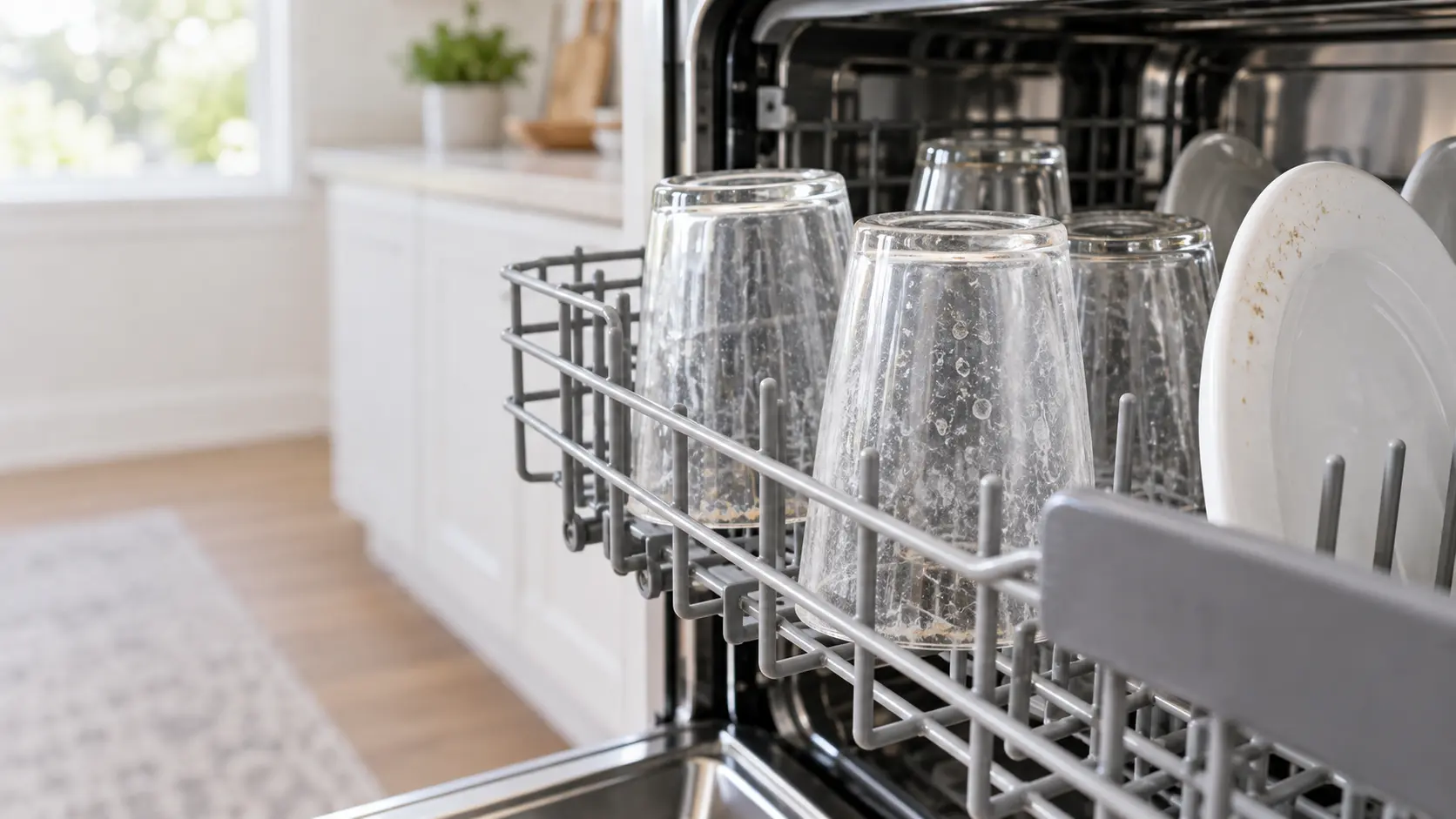
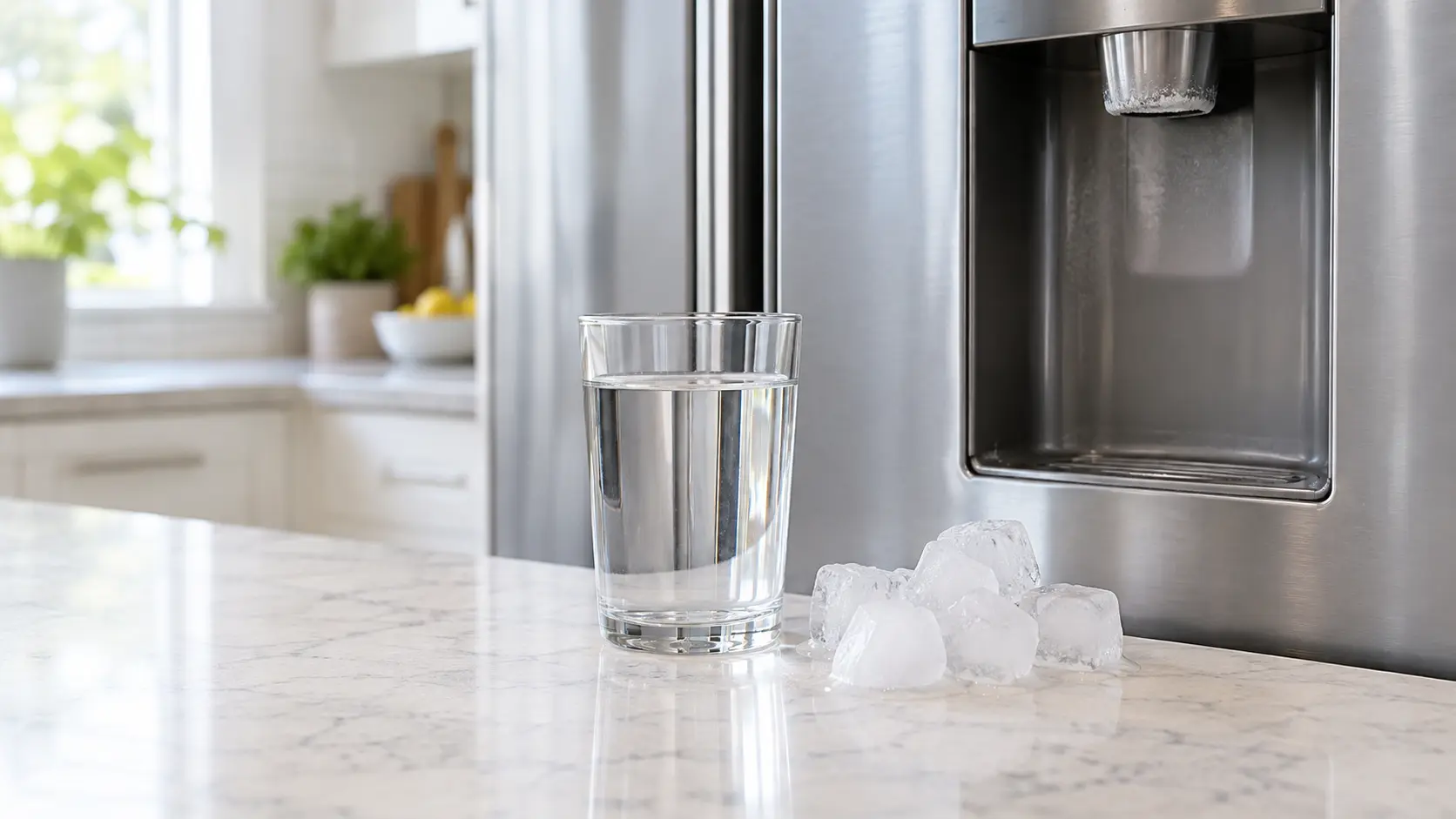
Evaporation is the second trigger. A drop of hard water that dries on a glass, a dispenser nozzle or a spray arm leaves its minerals behind, and the next drop adds to them. That slower route explains the white rim on a refrigerator's dispenser tray and the chalky ring inside a dish care door, far from any heater.
Reading your water's hardness number
EPA requires community water systems to send customers an annual drinking water quality report, due by July 1 each year, and the water supplier can send a copy on request. Whirlpool points owners to that report or to a hardness test kit from a hardware store. Homes on a private well have no report and need the kit. USGS uses these bands, measured as calcium carbonate:
- Up to 60 mg/L counts as soft
- 61 through 120 mg/L is moderately hard
- 121 through 180 mg/L is hard
- Anything above 180 mg/L is very hard
Source: USGS Water Science School — Hardness of water — Heated hard water forms calcium carbonate scale that reduces equipment life, raises heating costs, lowers electric water heater efficiency and clogs pipes; soft 0–60, moderately hard 61–120, hard 121–180, very hard above 180 mg/L
Dish care: film, spots and the softener setting
The dish care machine is where most households first see hardness. Whirlpool gives its machines an optimal range below 15 grains per gallon, and warns that heavier deposits do more than spot the glasses: they can restrict water flow and reduce heating efficiency inside the machine. Water above that level calls for a softener at the house or, on models that carry one, the built-in softener.
On Whirlpool models with a built-in softener, the system leaves the factory switched off at a hardness setting of zero. The owner enters the local hardness in the setting menu and fills the salt reservoir with dishwasher softener salt; until both are done, the softener does nothing. Rinse aid is the other lever. Whirlpool suggests a higher rinse aid setting when rings or calcium spots appear, and a full dispenser lasts about a month.
- Hardness entered in the setting menu, where the model has a softener
- Softener salt topped up whenever its indicator asks
- Rinse aid dispenser full, with the setting raised if spots persist
- Filters rinsed monthly, using a soft brush on calcium crust
Film or etching: the vinegar test
A cloudy glass has one of two causes. Film is a deposit sitting on the surface, often from hard water or too much detergent. Etching is permanent roughness in the glass, which Whirlpool links to water that is too soft, too much detergent and long hot cycles. Rub a little vinegar on the haze: if it wipes off, it was film and more hardness control helps; if it stays, softening further will make it worse.
Source: Whirlpool — Water hardness setting (dishwasher) — Find hardness in the water quality report or with a test kit; the softener ships off at setting 0; fill the reservoir with dishwasher softener salt; Whirlpool — Etching or cloudy glassware — Optimal hardness below 15 gpg; deposits restrict water flow and reduce heating efficiency; film wipes off with vinegar, etching does not and is linked to too-soft water; Whirlpool — How to fill and adjust the rinse aid dispenser — A higher rinse aid setting for rings or calcium spots; a full dispenser lasts about a month; Whirlpool — Cleaning the removable dishwasher filtration system — A soft brush may be needed for calcium deposits from hard water

Steam ovens and ice makers: the descale programs
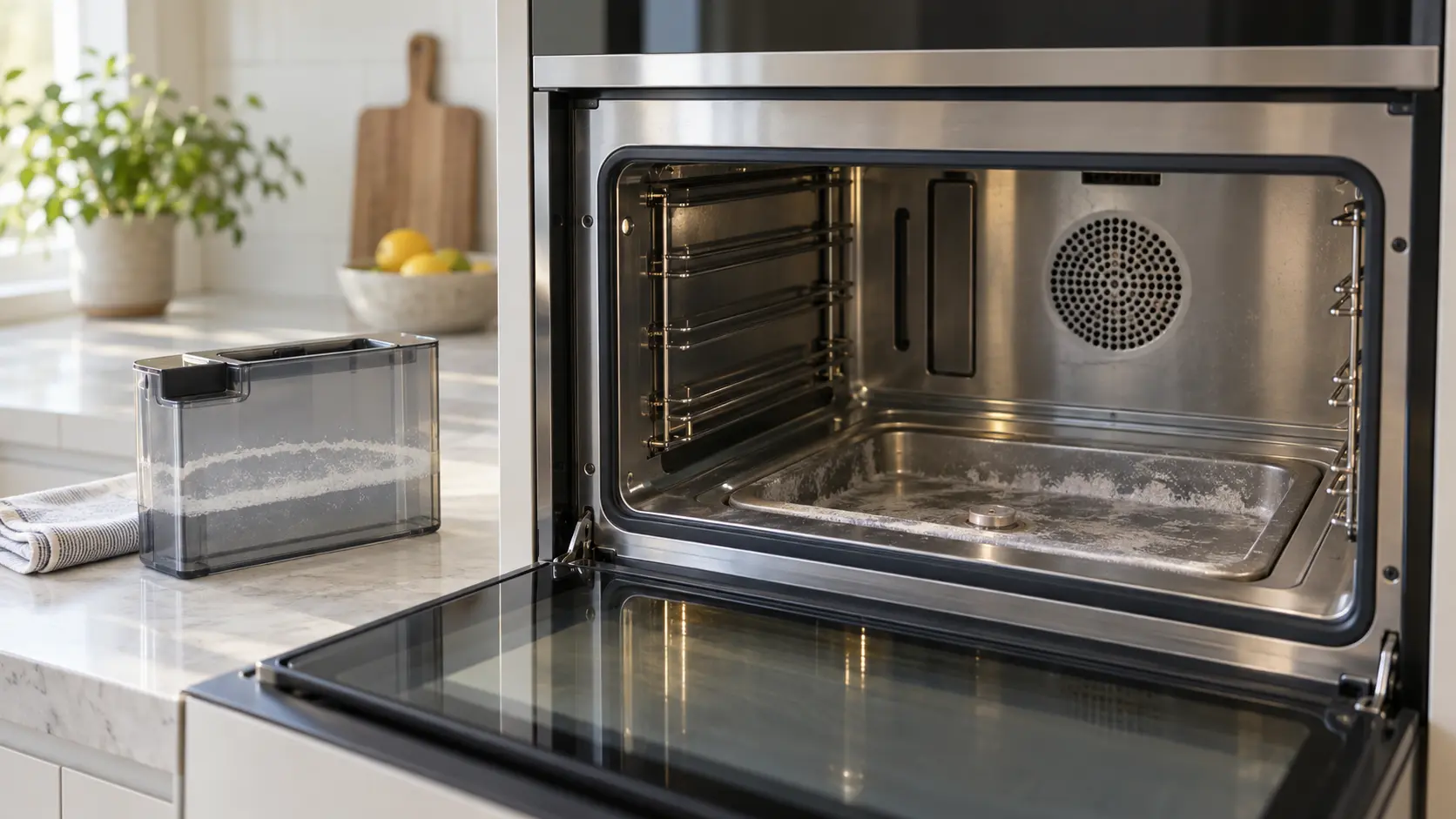
A steam oven boils water in a small boiler every time it cooks, so it collects scale faster than anything else in the kitchen. Wolf puts descaling for its convection steam ovens at every 6 to 18 months, depending on use and hardness, and the oven displays a message when the boiler needs it. Wolf names a single descaling solution, warns that vinegar may damage the unit, and notes that descaling more often than asked does no harm.
Countertop nugget ice makers sit at the other extreme. GE ties descaling on its Opal machines to the hardness of the water, with the interval shrinking sharply as hardness rises.
| Water hardness (grains per gallon) | Descale |
|---|---|
| 0 to 4 | Every 2 to 4 months |
| 4 to 7 | Every 1 to 2 months |
| 7 to 10 | Every 3 to 4 weeks |
| Above 10 | Every 2 to 3 weeks |
Why distilled water is not the cure for a steam oven
It sounds logical to feed a steam oven mineral-free water and never descale again. Wolf says not to: its steam ovens use an electromagnetic level sensor that needs minerals in the water to measure the fill accurately, so demineralized, reverse-osmosis and distilled water are all ruled out. Tap, filtered and softened water are all acceptable, and Wolf supplies a test strip so the owner can adjust a house softener to suit.
Source: Wolf (Sub-Zero Group) — Convection steam oven descaling — Descale every 6 to 18 months depending on use and hardness when the display asks; one named solution; vinegar may damage the unit; descaling more often does no harm; GE Appliances — Opal ice maker cleaning and descaling — Descaling interval by hardness: 0–4 gpg every 2–4 months, 4–7 every 1–2 months, 7–10 every 3–4 weeks, above 10 every 2–3 weeks
Other places scale shows up
The water heater feeding the dish care and laundry machines collects scale of its own, and USGS notes that it lowers the efficiency of electric water heaters in particular. Scale can also travel. Whirlpool explains that an ultrasonic humidifier throws a mineral mist into the room, and when that mist passes through a gas flame, calcium can color it orange or red and potassium lilac or pink, even with the humidifier in another room. A tinted flame in a hard-water home is not always a burner problem.
- White crust on the refrigerator dispenser nozzle and tray: wipe with a cloth dampened in white vinegar, then rinse
- Chalky spray arm holes in the dish care tub: clear them with a toothpick after removing the arm
- Orange flame tips only while a humidifier runs: fill the humidifier with distilled water, as Whirlpool suggests
- Steam oven message or slow fill: run the maker's descale program with the maker's solution
Source: USGS Water Science School — Hardness of water — Heated hard water forms calcium carbonate scale that reduces equipment life, raises heating costs, lowers electric water heater efficiency and clogs pipes; soft 0–60, moderately hard 61–120, hard 121–180, very hard above 180 mg/L; Whirlpool — Burner flames abnormal colors (natural gas) — Ultrasonic humidifier minerals color a flame: calcium orange or red, potassium lilac or pink; distilled water in the humidifier reduces it
Where owner descaling ends and a maintenance visit begins
Everything above runs through programs and parts the makers expect owners to handle. What sits inside the cabinet is different: the inlet valve screen on a refrigerator, the heating element and sump of a dish care machine, and water lines packed tight with mineral all need panels removed and water shut off, and some need parts replaced once scale has seized them. A maintenance visit looks at those places and at the water pressure feeding them.