What does the self-clean cycle actually do?
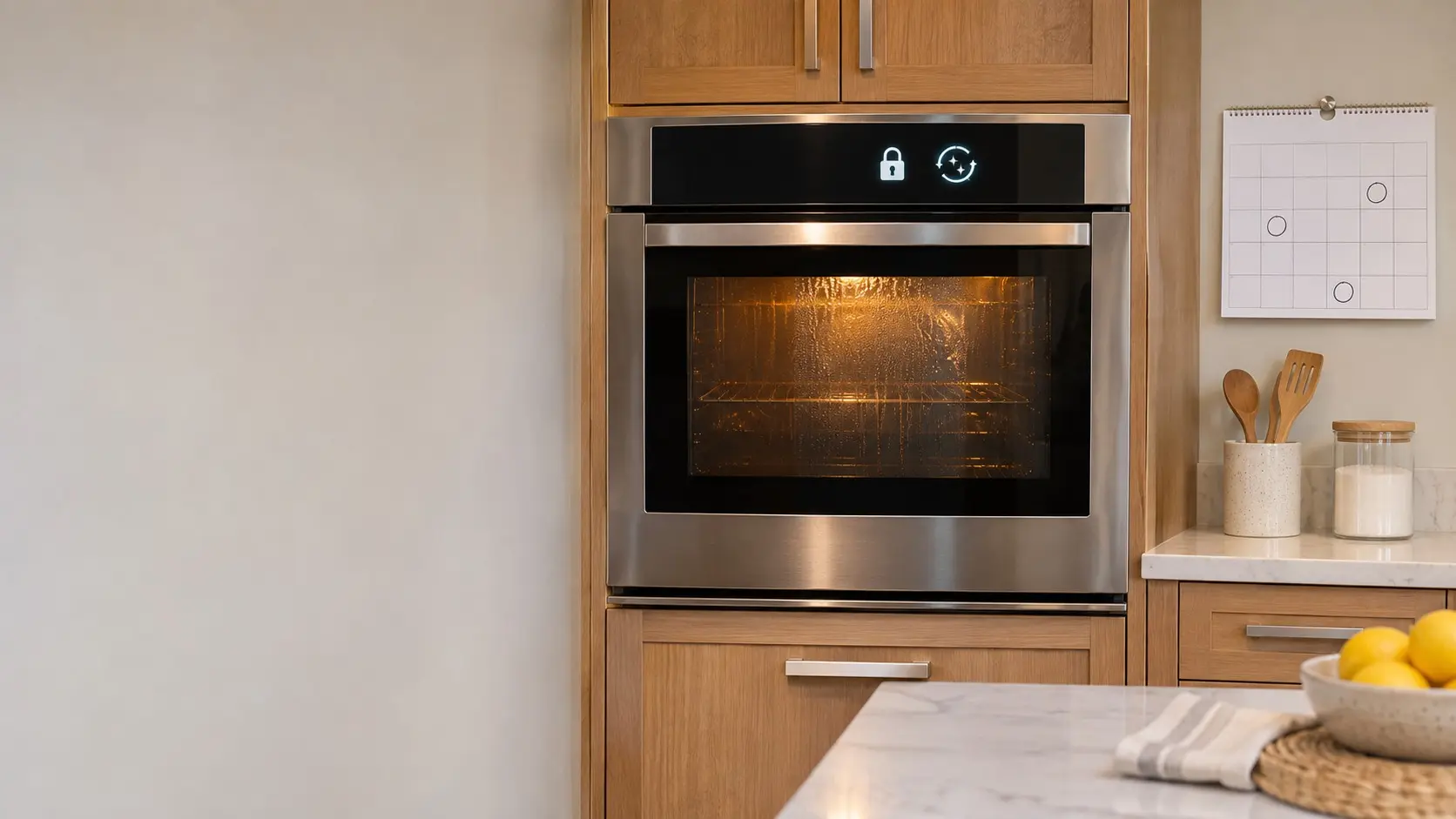
A high-heat (pyrolytic) self-clean cycle heats the cavity far above any cooking setting for several hours, which turns baked-on food into a loose gray ash. The owner's manual gives the cycle lengths your model offers. The door locks for the duration and stays locked until the cavity has cooled enough to be safe. Nothing in normal baking comes close to this temperature, so the parts that handle it age faster than the rest.
Four parts take most of that strain:
- The door latch motor and lock switch.
- The thermal fuse that protects the wiring.
- The control board and its connectors.
- The insulation and wiring close to the cavity.
Cleaning is therefore a trade: a clean cavity against a little extra wear, and the wear shows up as a failure at the least convenient moment.
Why not run it the week of a holiday meal?
The biggest risk is timing. If the latch jams or a fuse opens during or after a cycle, you find out when the oven should be cooking, and parts and a visit can take days. Running it the week before a holiday meal gives you no margin.
Failures tend to appear right after the cycle
The oven has just gone through its hardest test. A fuse that was weak opens, a lock that was sticky refuses to release, or a board that was marginal shows an error. These are not caused by the cleaning alone, but cleaning is where they surface.
A clean cavity right before a roast is not even better
A freshly cleaned oven can smoke slightly from cleaner residue or ash left in a corner. If you clean the same day you roast, you get the worst of both. For the usual cause of smoke, see why the oven smokes during a roast.
The kitchen is out of use
The cycle takes hours, then a cooling period, and the room gets hot and sometimes smells. That is easy to give up in a quiet week and hard to give up in a busy one.

When is a good time to run it?
Think in terms of a gap, not a date. Pick a period of at least two weeks with no major meal, run the cycle, then use the oven for a few ordinary bakes to confirm it behaves.
| Situation | Suggested timing | Why |
|---|---|---|
| Before the holiday season | Late October or early November | Leaves weeks to fix problems |
| Between big meals | Right after one ends, once the oven has cooled | Time to repair before the next |
| Heavy spill or burnt-on mess | As soon as it cools, with a hand clean first | Old residue smokes later |
| Week of a big meal | Do not run it | Use steam or hand cleaning |
| Oven with a history of lock or board problems | Avoid it, hand clean | The cycle may trigger the same problem again |
How often depends on how much you cook and how quickly you wipe spills; many households need the cycle only occasionally. Regular hand cleaning after heavy roasting means the cycle is rarely needed. The yearly upkeep calendar for the home shows where it fits among other seasonal jobs.
What should you do before starting a cycle?
Preparation keeps smoke and stress down and takes only a few minutes.
- Remove the racks, pans, pizza stones, foil and any thermometers, unless the manual says otherwise; most racks discolor or stick when they stay in.
- Wipe up loose crumbs and thick spills with a damp cloth, so they do not turn into heavy smoke.
- Do not use oven cleaner spray in a self-cleaning oven unless the manual allows it; most manuals say not to.
- Move pet birds to a well-ventilated room far from the kitchen before you start; many owner's manuals warn that the fumes from the cycle can harm them. Keep other pets out of the kitchen too.
- Clear anything stored on top of or beside the oven that could warm up.
- Open a window and turn on the hood fan for the whole cycle.
- Plan to be home. Someone should be in the house for the entire cycle and cool-down.
Once the cycle ends and the door unlocks, let the oven cool fully, then wipe the ash with a damp cloth. A little white ash at the door edge is normal. If you want to be sure the oven is still accurate afterward, see how to test oven temperature.
What are the alternatives in a busy week?
Many newer ovens offer a steam clean, a short low-heat cycle that uses a small amount of water poured into the bottom; the manual gives the amount and the steps. It loosens light soil, which you then wipe. This is far gentler on the latch and board, though it does not remove heavy buildup.
Hand cleaning works on every oven. Use a paste of baking soda and water on the floor and lower walls, leave it for several hours or overnight, and wipe it with a damp cloth. Take care around the element and any opening, and do not let liquid run into the vents or the control area.
Whichever method you pick, finish by running the empty oven at 350°F for about 15 minutes with the hood on, which burns off any trace of soap or paste before food goes in. Check the door gasket along the sides while you are there; a gasket that is frayed or flattened lets heat escape and should be replaced rather than scrubbed.
If the oven is gas, keep cleaner away from the burner ports and the igniter, and read gas burners and carbon monoxide if anything about the flame looks unusual. If you want the oven examined before a busy period, a diagnostic visit or a burner, igniter and gas connection check can do that, and the cooking appliance maintenance page lists what else belongs on the list. Early signs worth acting on are in signs an appliance is overdue for service.